词不达意,也是一种浪漫When Words Fall Short, It Is a Kind of Romance
AFTERWORDS v0.4 设计手记:由一首喜欢的歌和「词不达意」这个词出发,聊聊为什么表达不需要完美,以及一座小邮局为什么要给没说清楚的话留一个位置。AFTERWORDS v0.4 design note: starting from a favorite song and the idiom 「词不达意」 — words falling short — on why expression does not need to be perfect, and why a little post office should keep a place for the things we never quite say.
- AFTERWORDS
- 词不达意
- 产品设计
- AI 与表达
- 交互设计
- AFTERWORDS
- The Unsaid
- Product Design
- AI and Expression
- Interaction Design
AFTERWORDS v0.4 · 关于语言、表达与一座小邮局的设计手记
01 / 在制作网页的时候,我想起了一首歌
最近一直在完善一个叫 AFTERWORDS 的网页实验。
最初,我只是想把世界上不同语言表达“我喜欢你”的方式收集起来,做成一个可以交互的文字宇宙。
后来,它逐渐变成了一座能够自由书写、制作数字明信片的小邮局。
在继续思考这个项目的时候,我突然想到了一个词:
词不达意。
我本身就很喜欢《词不达意》这首歌,也一直觉得“词不达意”是一个非常浪漫的词。
它的字面意思其实并不浪漫。
想要表达的意思,没有被语言准确地传达出来。
但也正是这种不准确、不完整,甚至带着一点遗憾的感觉,让我觉得它很有意思。
尤其是在制作这个与语言有关的网页时,我开始重新思考:
我们究竟为什么需要语言?
以及,为什么即使拥有这么丰富的词汇,有时候还是无法说清自己的心情?
这也成为 AFTERWORDS v0.4 的起点。
02 / 越是重要的人,越容易词不达意
语言是人类交流的重要工具。
我们通过语言传递信息、表达观点,也借助语言建立和维系人与人之间的关系。
但我觉得,语言有一个很有趣的地方:
越是面对亲近的人、重要的人,我们有时反而越容易觉得词不达意。
面对普通的人际交流,我们或许可以很自然地组织语言。
但面对在意的人,一句简单的话可能就会被赋予更多含义。
“很高兴认识你。”
“最近怎么样?”
“我想你了。”
“谢谢你。”
这些都是再普通不过的句子。
但它们背后承载的情绪,可能远远超过文字本身。
我们有时候想表达关心,却担心显得冒昧。
想表达喜欢,却不知道怎样才能恰到好处。
想认真解释自己的想法,却发现越解释越复杂。
并不是没有语言可以使用。
而是想表达的东西本身,就很难被简化为几个准确的词语。
我觉得这种状态很微妙。
它可能让人遗憾,也可能带来误解。
但与此同时,那种认真斟酌、反复思考如何表达的过程,又有一种特别的浪漫。
因为在意,所以才会希望对方真正理解。
当然,词不达意不应该成为放弃沟通的理由。重要的事情仍然需要尽力说明白。
只是我越来越觉得,语言能够传达的,与我们内心真正感受到的,未必永远完全一致。
03 / 世界上有那么多种语言
这让我重新想起了 AFTERWORDS 最初的构想。
当时,我希望收集世界各地表达“我喜欢你”的不同方式。
中文、英语、日语,以及更多我并不熟悉的语言。
我觉得这些文字本身就很美。
不同的书写体系、发音方式和文化语境,让同一种看似相近的情感拥有了不同的表达形式。
但后来我也意识到,各种语言对于喜欢、爱、亲密和关心的区分,并不总能一一对应。
语言不是简单的词语替换。
它与文化、关系、语境,以及使用者想传递的情绪都有关系。
即使找到了一句在翻译上足够接近的话,也不代表它一定完整表达了我们真正想说的东西。
世界上有那么多种语言,可我们依然可能词不达意。
我觉得这件事有一点遗憾,也有一点浪漫。
因为语言并不完美,却仍然是我们理解彼此的重要方式。
而人们似乎也一直在尝试,为那些难以描述的心情寻找更合适的表达。
写信、送花、分享一首歌、制作一张明信片。
有时候,我们会借助文字之外的东西,补充那些没有说完整的话。
想到这里,我开始觉得,这个网页还可以有另一种可能。
04 / 所以,有了 AFTERWORDS v0.4
之前的版本中,我已经尝试过文字宇宙、互动情书和数字明信片。
用户可以选择不同语言的句子,也可以自由填写短句,为它们搭配不同的视觉设计。
但如果把“词不达意”作为新的设计主题,我希望改变的不只是页面上的一句文案。
我更想让这个想法真正参与产品设计。
第一,让用户可以从一张空白明信片开始。
不必先选择告白、思念或祝福。
也不需要一定写出一句足够漂亮的话。
有时候,可能只是:
“今天很开心。”
“突然想起你了。”
“很高兴见到你。”
又或者,只是一句暂时不知道该怎样继续的话。
我希望这些表达都可以被认真地保存下来。
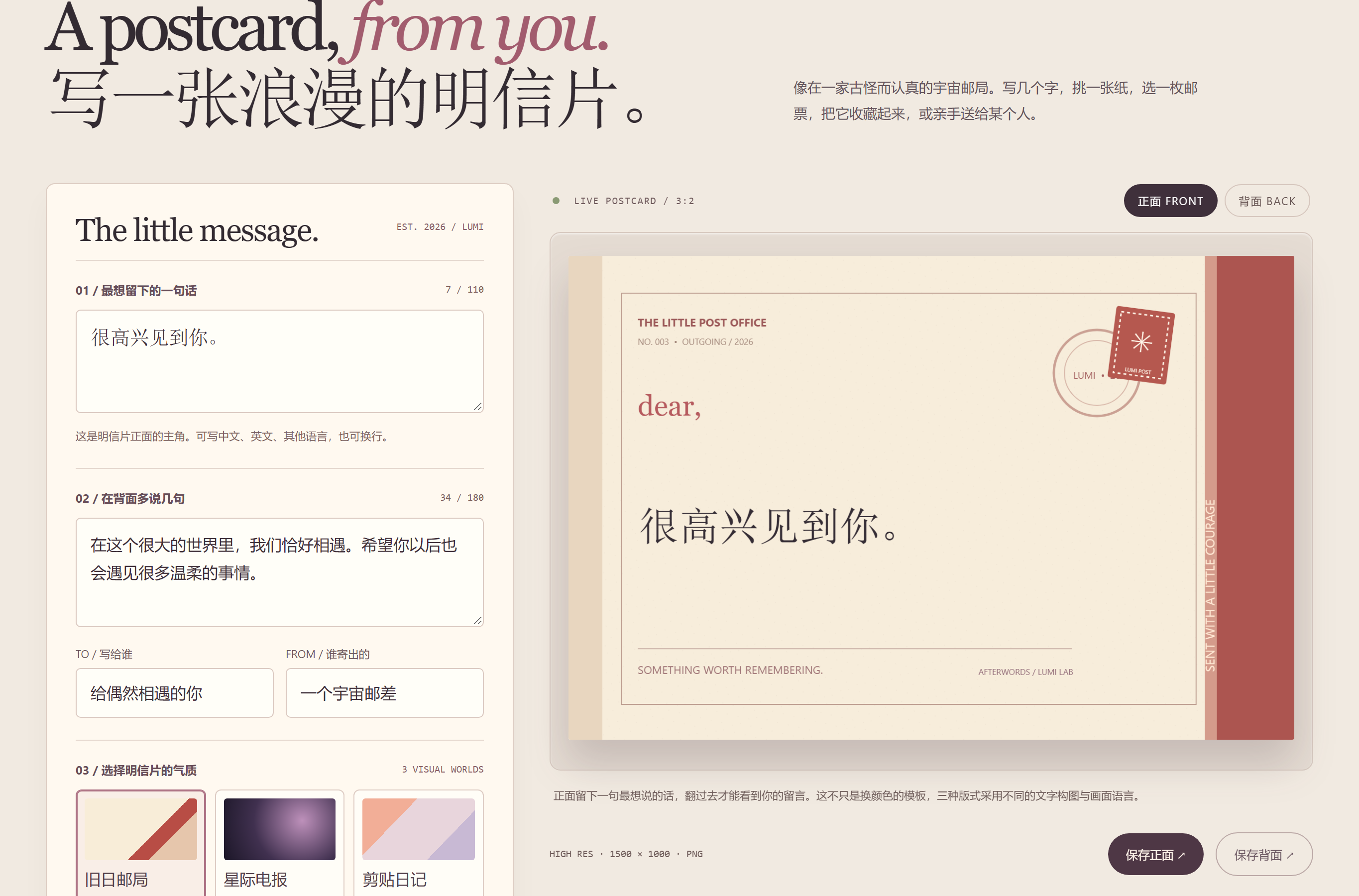
v0.3:先挑一句,再把它做成明信片。
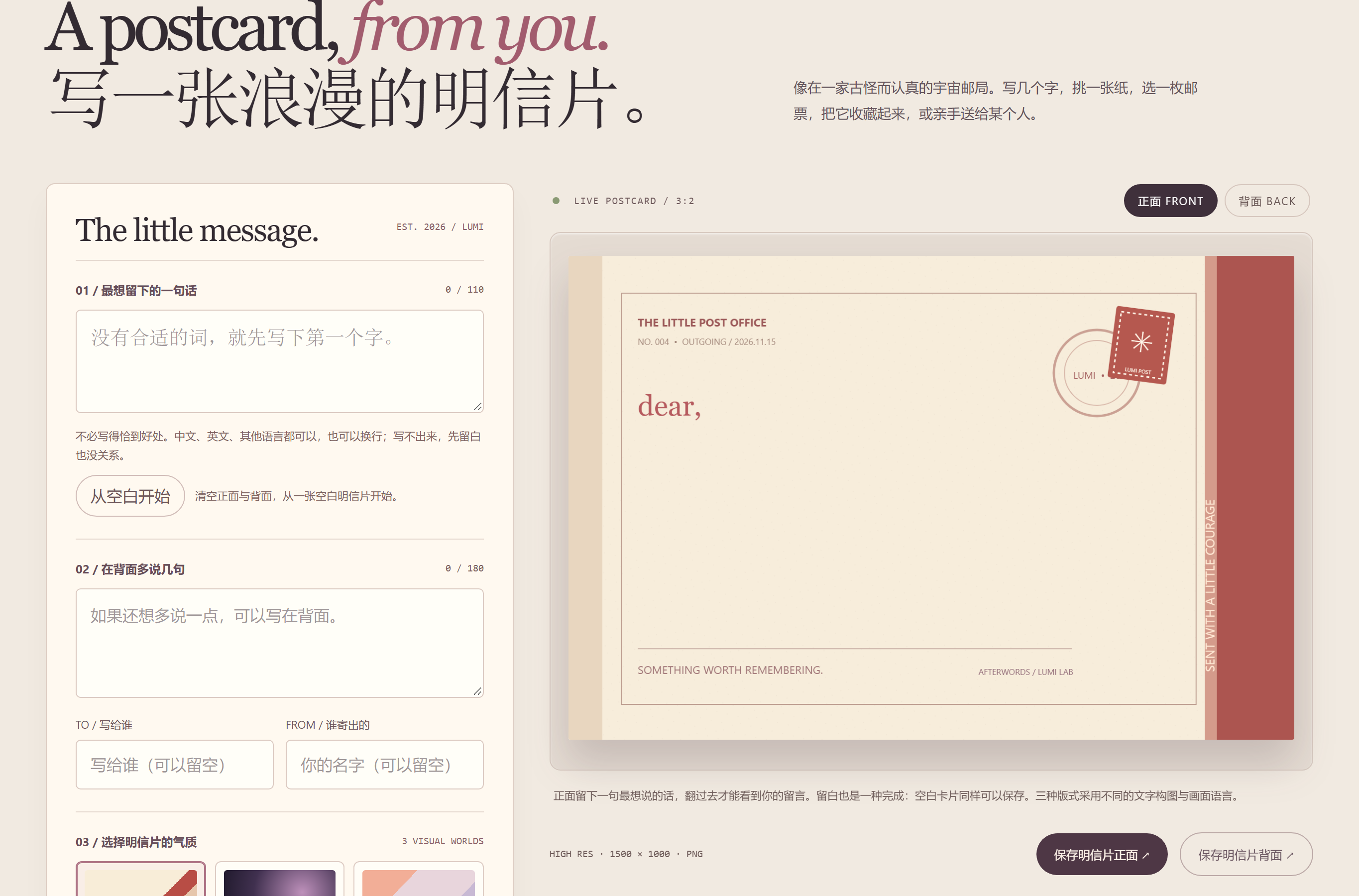
v0.4:空白成为默认状态——想写的人从零开始,不想写的人可以真的留白。
第二,让文字之外的视觉元素也参与表达。
同样一句话,写在暖黄色的复古信纸上,和放在一张深色星空明信片里,会呈现不同的情绪。
字体、排版、色彩、留白,甚至一枚小小的邮票,都可以成为表达的一部分。
它们不能代替文字,却可以帮助文字营造不同的感受。
第三,让创作过程保持足够自由。
我不希望用户必须完成一套复杂的流程,才能制作一张明信片。
可以认真挑选纸张、字体和装饰,也可以什么都不选,只写下一句话。
甚至不必追求所谓完美的表达。
有时候,一句简单、笨拙却真诚的话,已经足够。
这些构成了 AFTERWORDS v0.4 的新设计方向。
目前它仍然是一个持续完善中的版本。我希望通过后续实现和实际体验,检验这些设计是否真的能让表达变得更自然。
05 / 当 AI 越来越擅长表达
这个项目还有一个让我觉得很值得思考的地方。
AFTERWORDS 的技术实现主要借助 AI 编程工具完成。
在不断讨论、设计和修改网页的过程中,我也越来越频繁地接触到 AI 对语言的处理能力。
它可以翻译、总结、润色,也可以把一句简单的话扩展成一段非常漂亮的文字。
这些能力很有用。
但我偶尔也会想:
当我们可以轻易获得一段完美的表达,是否还愿意保留那些不够完美、却真正属于自己的话?
比如,我只是想对一个人说:
“认识你真好。”
这句话需要被润色吗?
未必。
它可能不够华丽,也没有什么特别精巧的修辞。
但它可以很真诚。
我觉得 AI 可以帮助人们更好地理解语言、组织语言,也可以在不知道如何表达的时候提供一些启发。
但它不一定需要替我们完成所有表达。
尤其是在这样一个带有个人情感的小实验里。
比起让 AI 自动生成一百句浪漫的话,我更希望用户愿意自己写下一句。
即使词不达意。
06 / 给那些没能说清楚的话,留一个位置
我想,这就是为什么我会喜欢“词不达意”这个词。
它提醒我,语言既重要,又有局限。
我们依赖语言理解世界,也通过语言靠近彼此。
但人与人之间的情感,未必总能被几句话完整地概括。
有时候,我们需要解释很多遍。
有时候,只需要一句简单的问候。
也有时候,我们会用一首歌、一张照片、一封信,去传递那些无法直接说清楚的心情。
在制作 AFTERWORDS 的过程中,我原本只是想收集世界上不同语言的“我喜欢你”。
后来,我想让人们可以写下任何一句自己想说的话。
而现在,因为《词不达意》这首我喜欢的歌,以及制作过程中产生的这些思考,我又想给这座小邮局增加一点新的意义。
它不一定能够帮人找到最准确的措辞。
也不一定能够解决人与人之间所有的误解。
但至少,它可以为一些想说的话提供一个小小的空间。
一句喜欢。
一声感谢。
一次相遇。
一份思念。
或者某种尚未找到合适名字的心情。
我想把这些都留在这里。
因为词不达意,我们才不断寻找表达的方式。
也正因为无法完全说清,才显得那些认真表达的瞬间格外珍贵。
也许,这就是我所理解的浪漫。
AFTERWORDS v0.4「词不达意」是一个持续迭代中的个人网页实验。上一篇文章记录了从多语言“我喜欢你”到浪漫明信片的创作过程,这一篇记录的是,在制作过程中,由一首喜欢的歌和一个词延伸出的新思考。
技术实现主要借助 AI 编程工具完成,项目仍在持续探索文字、交互与情感表达之间的关系。
实验档案
- 实验名称: AFTERWORDS v0.4「词不达意」
- 当前阶段: v0.4 已于 2026-11-15 上线。「从空白开始」、空白明信片导出(导出内容经逐像素验证,不会自动补充任何未输入的文字)、双面明信片与三种版式均已实现并通过浏览器自动化验证
- 在线体验: 词不达意明信片工坊
- 系列: v0.2 文字宇宙与情书 · v0.3 浪漫明信片 · 上一篇设计过程手记
AFTERWORDS v0.4 · A design note about language, expression and a little post office.
01 / While building the page, a song came back to me
Lately I have been refining a web experiment called AFTERWORDS.
It began as an attempt to collect the different ways the world says “我喜欢你” — I like you — and turn them into an interactive universe of words.
Later it gradually became a little post office where you can write freely and make digital postcards.
While thinking about the project, a word suddenly came to me:
词不达意 — words falling short.
I have always loved the song《词不达意》, and I have always found the idiom itself romantic.
Its literal meaning is not romantic at all.
The meaning you want to express does not come through the language accurately.
But it is exactly this inaccuracy, this incompleteness, this faint sense of regret that I find interesting.
Especially while building a page about language, I started to rethink:
Why do we need language at all?
And why, with such a rich vocabulary, do we still fail to describe how we feel?
That became the starting point of AFTERWORDS v0.4.
02 / The closer the person, the more words fall short
Language is an essential tool for human connection.
We pass on information and opinions through it, and use it to build and maintain relationships.
But I think language has an interesting quirk:
The closer and more important the person, the more likely we are to feel that words fall short.
With everyday exchanges, we can organize our words quite naturally.
But with someone we care about, even a simple sentence can carry far more weight.
“Nice to meet you.”
“How have you been?”
“I miss you.”
“Thank you.”
These are the most ordinary sentences.
Yet the feelings behind them may far exceed the words themselves.
Sometimes we want to show care but worry it comes across as intrusive.
Sometimes we want to say “I like you” but cannot find the right degree.
Sometimes we try to explain ourselves carefully, only to make things more complicated.
It is not that we lack language.
It is that what we want to express resists being reduced to a few precise words.
I find this state delicate.
It can bring regret, and it can cause misunderstanding.
But at the same time, the process of weighing and re-weighing how to say something has its own special romance.
Because we care, we want the other person to truly understand.
Of course, words falling short should not become a reason to give up on communication. Important things still deserve our best effort to be said clearly.
Only, I increasingly feel that what language can convey and what we actually feel inside are not always the same.
03 / There are so many languages in the world
This brought me back to AFTERWORDS’ original idea.
At the start, I wanted to collect the different ways the world says “I like you”.
Chinese, English, Japanese, and many languages I barely know.
I find the written forms beautiful in themselves.
Different writing systems, sounds and cultural contexts give a similar feeling different shapes.
But I also came to realize that languages do not map neatly onto each other when it comes to like, love, intimacy and care.
Language is not word substitution.
It is entangled with culture, relationships, context, and the mood the writer wants to pass on.
Even a translation that is close enough does not necessarily carry everything we meant to say.
There are so many languages in the world, and we can still fall short of words.
I find that a little regretful, and a little romantic.
Because language is imperfect, yet it remains an essential way for us to understand each other.
And people keep trying to find better expressions for the feelings that are hard to describe.
Letters, flowers, sharing a song, making a postcard.
Sometimes we reach for things beyond words to complete the sentences we could not finish.
Thinking of that, I started to feel the page could have another possibility.
04 / So AFTERWORDS v0.4 came into being
In earlier versions I had already tried a word universe, interactive letters and digital postcards.
Users could pick sentences in different languages, write their own, and match them with different visual designs.
But if “words falling short” became the new design theme, I wanted to change more than a line of copy.
I wanted the idea to genuinely take part in the product design.
First, let users start from a blank postcard.
No need to pick confession, longing or blessing first.
No need to write something beautiful enough.
Sometimes it is just:
“Today was fun.”
“I thought of you again.”
“Nice to meet you.”
Or a sentence you do not yet know how to continue.
I want these expressions to be kept with care.
v0.3: pick a phrase first, then turn it into a postcard.
v0.4: blank is the default — those who want to write start from zero, and those who do not can truly leave it empty.
Second, let the visual elements beyond words take part in the expression.
The same sentence feels different on warm vintage letter paper than inside a dark starry postcard.
Typeface, layout, color, white space, even a tiny stamp — all of it becomes part of the expression.
They cannot replace words, but they help words set a mood.
Third, keep the creative process free enough.
I do not want users to complete a complicated flow before they can make one postcard.
You can carefully pick paper, typeface and decoration — or pick nothing at all and write one sentence.
You do not even have to aim at a perfect expression.
Sometimes a simple, clumsy, sincere sentence is already enough.
These make up the new design direction of AFTERWORDS v0.4.
It is still a version being refined. I hope later implementation and real use will show whether these designs actually make expression feel more natural.
05 / As AI gets better at expressing things
There is another part of this project I find worth thinking about.
AFTERWORDS is built mainly with AI coding tools.
Through all the discussing, designing and revising, I keep encountering how well AI handles language.
It can translate, summarize, polish, and stretch one plain sentence into a beautiful paragraph.
These abilities are useful.
But now and then I wonder:
When a perfect expression is this easy to obtain, are we still willing to keep the imperfect words that are truly ours?
Say I only want to tell someone:
“It’s so good to have met you.”
Does that sentence need polishing?
Probably not.
It is not ornate, and its rhetoric is nothing clever.
But it can be sincere.
I think AI can help people understand language better, organize language better, and offer inspiration when words are hard to find.
But it does not need to finish all of our expressing for us.
Especially not in a small, personal experiment like this one.
Rather than having AI generate a hundred romantic sentences, I would rather see users willing to write down one sentence of their own.
Even if the words fall short.
06 / Keep a place for the things we never said clearly
I think this is why I like the word 词不达意.
It reminds me that language matters, and that it has limits.
We rely on language to understand the world, and we use it to reach each other.
But the feelings between people are not always captured by a few sentences.
Sometimes we need to explain many times.
Sometimes a simple greeting is enough.
And sometimes we use a song, a photo, or a letter to pass on what cannot be said directly.
When I started AFTERWORDS, I only meant to collect the world’s versions of “I like you”.
Later, I wanted people to be able to write anything they wanted to say.
And now, because of the song I love, and the thoughts that surfaced while building it, I want to give this little post office one more meaning.
It will not necessarily help anyone find the perfect wording.
It will not resolve every misunderstanding between people.
But at least it can offer a small space for things that want to be said.
A liking.
A thank-you.
A meeting.
A longing.
Or a feeling that has not found its name yet.
I want to keep all of these here.
Because words fall short, we keep searching for ways to express.
And precisely because nothing can be said completely, the moments of earnest expression shine.
Maybe that is the romance as I understand it.
AFTERWORDS v0.4 「词不达意」 is an ongoing personal web experiment. The previous article recorded the making of it, from multilingual “I like you” to the romantic postcards; this one records the new thoughts that grew out of a favorite song and a single word.
The implementation is done mainly with AI coding tools, and the project keeps exploring the relationship between words, interaction and emotional expression.
Experiment file
- Experiment name: AFTERWORDS v0.4 「词不达意 / The Unsaid」
- Current stage: v0.4 went live on 2026-11-15. “Start from blank”, blank-postcard export (verified pixel by pixel — no text you did not type is ever added), two-sided postcards and three layouts are implemented and verified with browser automation
- Try it: The unsaid postcard studio
- Series: v0.2 word universe & letters · v0.3 romantic postcards · Previous design-process note
写什么都可以。
不必写得那么准确。
A LITTLE SPACE FOR YOUR WORDS文字只留在这一页,不会保存或上传。去写一张真的明信片 ↗