CASE STUDY
2026.10.15–10.24 · 个人项目 · AI 协作Oct 15–24, 2026 · Personal project · AI-assisted
CyberCare:把 AI 识别结果留在草稿里
CyberCare 最早是一个玩笑:用户捐款后,让屏幕里的虚拟人磕头致谢。后来,我们把问题收窄到一张活动海报:如果图片里的文字太小、信息太散,能不能先整理成方便复制和放大阅读的内容?
我围绕场景选择、人工核对、失败边界和验收推进原型,实现由 AI 编程工具协助完成。社区工作人员、志愿者和信息接收者是设想中的使用者;这项场景选择还没有经过目标用户研究。
海报没写报名方式,草稿也应该留空
原型提取四项信息:活动名称、时间、地点和报名方式。它们看起来简单,但一个错误的时间或报名入口,足以让一份排版清晰的通知失去用途。
因此,AI 的输出只是一份待核对草稿。海报没有写报名方式时,系统不能补一个“联系社区工作人员”;缺少年份、地点不清楚时,也要保留待核实的信息。用户可以对照原图修改,未知项同样需要明确确认。
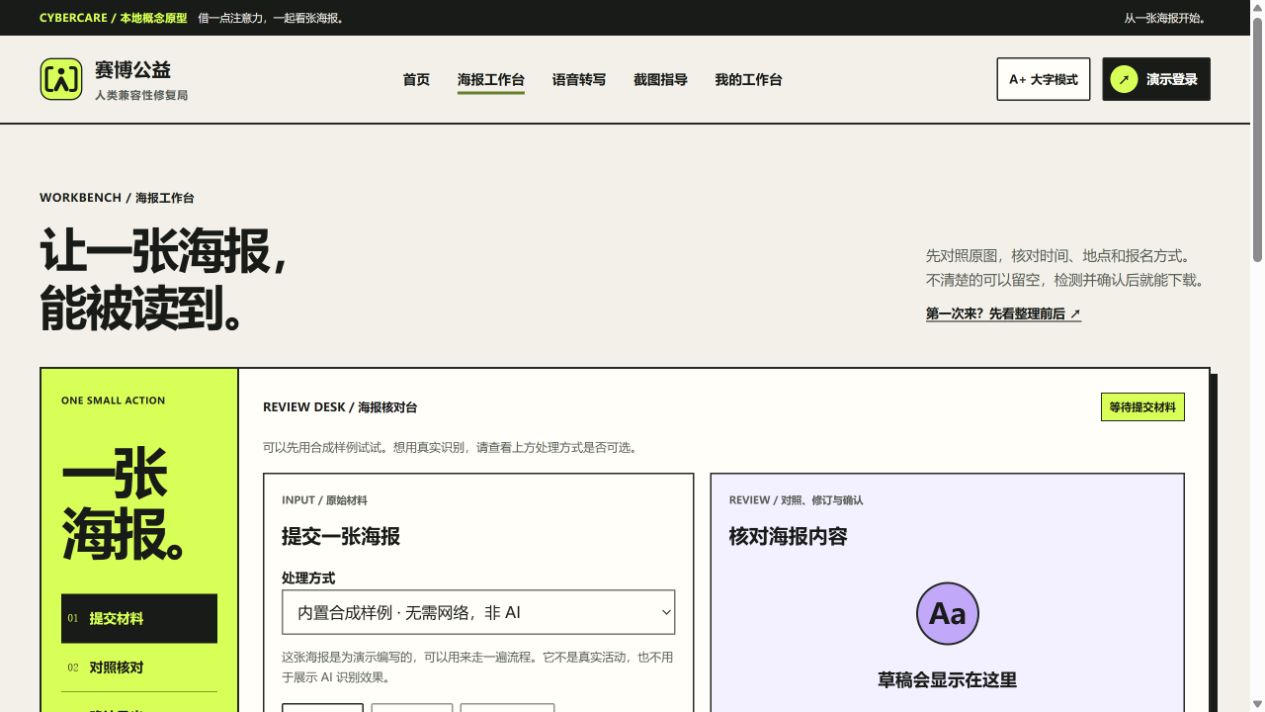
2026 年 10 月 24 日的公开工作台截图。画面展示内置合成样例入口和待生成草稿,不是真实活动,也不展示模型识别质量。
检测通过以后,仍然要看原图
海报流程是:提交材料 → 查看草稿 → 修订 → 检测 → 逐项确认 → 导出文字、大字 HTML 和核对记录。
自动检测检查的是页面结构等可被工具发现的问题,不能判断活动日期是否正确。人工确认则记录“有人核对过”,也不保证核对没有遗漏。两者的职责需要分别说明。
另外,检测和确认必须对应最终导出的版本。如果用户修改了地点,旧版本的检测结果与确认就不能继续使用。这个限制会多一步操作,但能避免把一张旧回执贴到新内容上。
一次成功的转写,也留下了一个错误地点
加入短音频转写后,历史测试出现过一个很具体的错误:本机合成通知说的是“示例活动室”,ASR 输出了“市立活动室”,摘要又沿用了这个地点。
接口成功返回了,输出结构也可以处理,但地点已经变了。这次材料是合成语音,不能据此计算真实语音准确率;它足以提醒我们,把转写送进摘要并不会自动纠错。
语音结果因此需要回听、修改和确认。截图指导也只围绕当前截图给出一步建议,不代替用户执行;原型没有因为接入更多模态,就取消人的判断。
有趣的入口,需要允许跳过
那个最初会磕头的角色被保留下来,但互动使用预设台词,不能描述成实时 AI 对话。用户可以直接进入工作台,也可以关闭动作。
这项取舍来自一个尚待验证的想法:幽默可能让人愿意停留,却不应该成为获取信息的门槛。我们不能拿角色的吸引力,替代接收者是否读得懂、用得上的证据。
当前做到了哪里
截至本次核对,公开原型可以访问,海报、语音和截图入口存在,仓库保留了本地回归与有限真实模型测试记录。本轮只检查了公开页面、只读健康和配置接口,没有上传材料、调用模型或启动虚拟人会话。
这些证据支持“原型已实现并可展示”,不支持整体识别准确率、原生读屏验收、正式无障碍认证、机构采用或公益影响。公开部署、源码版本和历史测试也需要分别核对。
下一步应该请一位通知整理者和一位接收者,用有权使用的材料完成一次具体任务:整理者花多久核对,接收者能否找到正确的时间、地点和报名方式,以及它是否比原来的办法方便。目前还没有这组结果。
创意的来由另记在项目手记;这里保留原型中的具体约束与未验证项。
CyberCare: keeping AI extraction as a draft
CyberCare began as a joke: after a donation, a virtual character would kneel and bow its head to thank the donor. We later narrowed the problem to an event poster. If its text is small and its information scattered, could we organize it into something easier to copy and read at a larger size?
I worked on scenario selection, human review, failure boundaries, and prototype acceptance, with implementation assisted by AI coding tools. Community staff, volunteers, and information recipients are prospective users; this choice has not yet been validated through target-user research.
If registration details are missing, leave them missing
The prototype extracts four fields: event name, time, location, and registration method. A wrong time or signup link can make an otherwise readable notice useless.
AI output therefore remains a draft awaiting review. If registration details are absent, the system should not invent “contact community staff.” Missing years and unclear locations also need explicit uncertainty. People can compare the draft with the source, make edits, and confirm unknown fields as unknown.
Public workbench captured on October 24, 2026. It shows the built-in synthetic-sample entry and empty draft area, not a real event or a demonstration of model accuracy.
Passing a check does not replace reading the source
The poster flow is: submit material → inspect the draft → revise → run checks → confirm individual items → export text, large-print HTML, and review records.
Automated checks look for issues such as detectable page-structure problems. They cannot establish that an event date is correct. Human confirmation records that someone reviewed the information, but does not guarantee they missed nothing. These responsibilities need separate explanations.
Checks and confirmations must also correspond to the exported revision. If someone changes the location, the old check and confirmation cannot remain valid. This adds a step, but prevents attaching an old receipt to new content.
A successful transcription still produced a wrong location
An earlier short-audio test exposed a concrete error. A locally synthesized notice said “示例活动室”; ASR produced “市立活动室”, and the summary repeated that location.
The request succeeded and the output was structurally usable, yet the place name had changed. Synthetic speech cannot establish real-audio accuracy. It does show that feeding a transcript into a summary does not automatically correct its errors.
Audio results need listening, edits, and confirmation. Screenshot guidance is limited to one suggested step based on the current screenshot, with the person performing the action. Adding modalities does not remove human judgment.
A playful entrance must be skippable
The original character remains, but its interactions use preset lines and should not be called real-time AI conversation. People can enter the workbench directly and disable motion.
The hypothesis is that humor may earn attention without becoming a barrier to information. Its appeal cannot stand in for evidence that recipients can understand and use the result.
What the evidence currently supports
At this review, the public prototype was reachable and poster, audio, and screenshot entry points existed. The repository retains local regression and limited real-model test records. This review only inspected public pages and read-only health/configuration endpoints; it uploaded no material, called no models, and started no avatar session.
That supports describing an implemented, demonstrable prototype. It does not establish overall extraction accuracy, native screen-reader acceptance, formal accessibility certification, adoption, or social impact. Deployment state, source revisions, and historical tests also need separate attribution.
The next useful test is one authorized notice handled by a preparer and a recipient: how long review takes, whether the recipient finds the right time, location, and registration method, and whether this is easier than their existing approach. Those results are not available yet.
The project journal tells the origin story. This case keeps the constraints and outstanding validation visible.
Sources: public prototype, fixed-source multimodal test records, and deployment records.